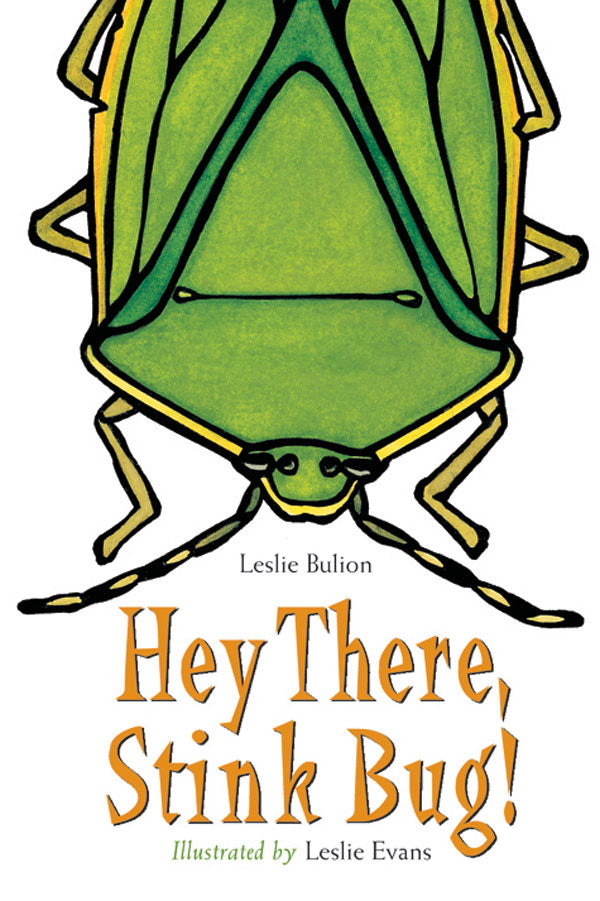
Hey There, Stink Bug!

Leslie Bulion, author
Leslie Bulion started writing stories for children in 1998, and her first book, Fatuma's New Cloth (Moon Mountain), won the 2003 Africana Book Award. Leslie lives in Durham, Connecticut.
Read more about Leslie Bulion.
Leslie Evans, illustrator
Leslie Evans has illustrated many books including Leaf Jumpers, The Yummy Alphabet Book, and the Alphabet Acrostic series (Clarion). Leslie lives in Watertown, Massachusetts, where she delights in her daily walks along the Charles river with her dog, Clyde.
Read more about Leslie Evans.
- Book Sense Winter 2006-2007 Children's Pick List
- ABC Best Books for Children
- Librarians' Choices 2006: Texas Woman's University
- Bookbuilders of Boston New England Book Show Winner
Booklist
"This is/an insect world with humans in it./We'll seize the day, but they will win it." The insects featured in this poetry collection are fearsome, awe-inspiring creatures. Bulion uses gory, visceral facts to pull children into both the science and the various poetic forms. What happens to an ant that falls into a doodlebug's hole? "Grabbed-stabbed-and-poisoned, its juices sucked out." How does a wolf spider treat an unruly youngster? "She'll pierce then pulverize him for a snack." Prose paragraphs about the bugs accompany each poem, but readers may still need help with sophisticated allusions and wordplay. Many selections, though, are immediately accessible, and the words' frank, gross-out drama will generate lively enthusiasm: "Cow manure/hog manure/roadkill corpse/an open sewer" reads the marching lines of maggot's preferred menu. Striking, watercolor-washed linoleum prints and notes about poetic forms round out this title, which can be used across the curriculum. Pair it with Marilyn Singer's Fireflies at Midnight (2003) and Joyce Sidman's Songs of the Waterboatman and Other Pond Poems (2005).
School Library Journal
The poems in this collection flit and buzz effortlessly from page to page as members of the insect world are showcased in a variety of poetic forms, from haiku to clerihew. Antlions, skipper caterpillars, and even dung beetles make appearances. A brief annotation accompanies each poem, providing a few juicy factoids for budding entomologists while ever-present humor pulls in all fans of anything gross. In "The Hot Shot;" a bombardier beetle blasts hot acid from its "seatle," and in "Advice to a Caterpillar," a swallowtail warns the larva to "pretend you're bird poop." Notes at the book's end dissect each poem's formal elements, and a glossary clarifies scientific terminology. Evan's naturalistic block prints crawl through the text, echoing the lighthearted tone. For readers or teachers who go buggy for Douglas Florian's Insectlopedia (Harcourt, 1998) or Paul Fleischman's sophisticated Joyful Noise (HarperCollins, 1988), suggest Hey There, Stink Bug! They'll laugh, they'll learn, and hopefully they won't lose their lunch!
The Bulletin of the Center for Children's Books
In just under a score of poems, Bulion addresses various denizens of the insect world in witty, tightly structured verse, with an informational prose sidebar about the subject accompanying each poem. Entries treat critters such as the bombardier beetle ("slow on the wing but thinks fast on its feetle"), spiders ("I dreamed a spider from the ceiling/dropped into my mouth"), and flies ("real flies feed on ghastly things"), as well as the insect world generally ("This is/ an insect world with humans in it"), in poetic forms ranging from free verse to the sonnet, the limerick to the haiku. This resembles Sidman's Song of the Water Boatman (BCCB 7/06) in its sparkling blend of biology and poetry, but the poetic approach here emphasizes humor, making these well-crafted verses eminently suitable for reading aloud to spice up an entomology unit or offering on the relevant buggy spot during a fly-distracted language arts lesson. A glossary is included, notes describe in some detail the poetic devices and formats employed in each entry, and there's a handy list of insect resources of the web and in print.
Science Books & Films
The major portion of this book consists of 19 poems, all but the last accompanied by a brief, simple, accurate, and informative commentary that provides additional biological information. As subjects, insects are in the majority, but two poems feature spiders. The poems surely are not grist for the poet laureate selection mill; nevertheless, they are entertaining, though occasionally a tad crude. Kids will love them. Upper elementary to middle schoolers will read the poems with ease; younger children will enjoy hearing them read. The various poetic styles employed by the author are described in a separate section, and the information imparted there could well be used in literature classes. The color illustrations are attractive and well coordinated with the text. The binding is sturdy, and the bright yellow cover, adorned only by a pair of black carpenter ants, will attract the eye. A helpful glossary and a bibliography consist of three good books and the addresses of two useful Web sites.
The Reading Teacher
Hey There, Stink Bug! is a multigenre book that incorporates poetry, interesting facts about a variety of bugs, and information about the different forms of poetry used. This clever text, appropriate for a variety of grade levels, demonstrates how authors often mix genres to make the information or writing more interesting and fun. Poems like "The Hot Shot" are sure to entertain as it reads "Bombardier bombardier bombardier beetle, slow on the wing but thinks fast on its feetle. Blasting poor predators into retreatle, with boiling hot acid it aims from its seatle" (p. 13). The informational text that follows on the same page will captivate any bug enthusiast: "When an enemy bothers a bombardier beetle, two chemicals mix inside the beetle and explode with a pop into acid spray."
Mini-lessons for using this text could range from a broad lesson on how mixing genres while writing can be effective to more discrete lessons on how writers choose the most compelling information to keep readers interested. During a unit on nonfiction writing, a teacher could copy the informational text from the bombardier beetle page onto a chart and add to it some less interesting facts. The teacher could then model how to choose the most compelling information to write about, thinking aloud while doing so. Another use for this book would be to share one of the poems during a mini-lesson, focusing on its form. Students would begin to "try out" the form by drafting some lines.
Also included at the back of the book are texts and online resources about bugs. The Franklin Institute's Resources on Science (www.fi.edu/qanda/spotlight2/spotlight2.html) is one of the sites referenced. Students can use this site as a reliable resource to develop background knowledge about bugs, which will make it easier for them to understand and enjoy Bulion's poems. The site can also be used to support any informational writing students may choose to do on bugs.
Hardcover
ISBN: 978-1-58089-304-6
Paperback
ISBN: 978-1-58089-340-4
E-book PDF
ISBN: 978-1-60734-040-9
Ages: 7-10
Page count: 48
5 1/2 x 8 1/4