Faces of the Moon


Bob Crelin, author
Bob Crelin is the author of There Once was a Sky Full of Stars. Bob was awarded the Astronomical League's Walter Scott Hudson Award for his tireless work to preserve the night sky for future generations. He lives in Guilford, Connecticut.
Read more about Bob.
Leslie Evans, illustrator
Leslie Evans has illustrated many books including Leaf Jumpers, The Yummy Alphabet Book, and the Alphabet Acrostic series (Clarion). Leslie lives in Watertown, Massachusetts, where she delights in her daily walks along the Charles river with her dog, Clyde.
Read more about Leslie.
- A Book Links Lasting Connections
Kirkus Reviews
Listeners may appreciate the rhythm, but most insight will come from the visual clues. Strategically placed die-cuts show the moon as it waxes or wanes with each page turn. Tabs are also cut into the border and marked with images of the changing moon, forming a timeline at the book's edge. Evan's blockprint illustrations, carved with precision, echo the slices of moon that are shaved away. In contrast to the rhyming text, a simple end note clearly explains this lunar dance of shadow and light. Fun "Moon Memo-Rhymes" are also included to help remember moon facts.
NSTA Recommends
What a completely unique book—so unique, in fact, that it's difficult to describe! In it, readers will find text written in couplets, phases of the Moon marked by tabs, and corresponding cutouts that make page turning feel like animation. Strikingly colorful illustrations add vitality to the descriptions that carefully label and describe each of the Moon's eight phases.
"WAXING GIBBOUS, fat with light, she's nearly round-up late at night."
"At Moon's LAST QUARTER of her trip, her eastern half is brightly lit."
And on it goes. The book ends with additional information (written in paragraph form) and a page of "moon Memo-Rhymes," a charming array of reminders about lunar facts. "Her orbit is the circled flight that makes the Moon Earth's satellite."
Even those who thought they had no more than a passing interest in our planetary neighbor will find this clever text a treat an an education. It might be read aloud as an introduction to age-appropriate lunar observations, placed at a center for further reference, or become the basis for a collection of student's drawings or photographs.
Publishers Weekly
With gentle interactive elements and rhymed verse, this picture book strikes a reflective tone while providing an effective lesson on the moon and its phases. A boy, a girl and a dog gaze up a the moon and wonder "just why her face is curved, or round,/or why she sometimes can't be found?" During each of the moon's phases, the children are pictured engaging in various activities while the moon shines above them, peeking through die-cut pages: "Now WAXING GIBBOUS, fat with light,/she's nearly round—up late at night." The pages also have side tabs that show the moon in its corresponding phases. Evans's bright, chunky linoleum block print and watercolor illustrations present the moon as a constant presence in the children's lives, sometimes as a pale backdrop for everyday events, at other times a source of wonderment.
School Library Journal
Die-cut holes—starting with a big round one on the front cover—track the Moon's phases as seen in the northern hemisphere. While Crelin explains what's happening in verse ("The Moon's first phase, we call it NEW—/when Moon's between the Sun and you./Her sunlit side is turned away,/and we can't see her, night or day"), and then (superfluously) again in prose at the end, Evans's digitally enhanced linoleum-block prints depict two children watching the sky or going about their daily or nightly business in a variety of urban and outdoor settings. . . Consider this volume as an enhancement for more conventional treatments such as Suzanne Slade's The Phases of the Moon (Rosen) or Franklyn Mansfield Branley's classic The Moon Seems to Change (HarperCollins).
Booklist
It isn't easy to cram science lessons into graceful poetry, but Crelin makes it look effortless in this appealing ode to the moon and its phases. An unnamed brother and sister serve as visual anchors through verses that culminate in a section that devotes two pages to each phase. This area is tabbed for easy access (each tab features a picture of the appropriate phase) and includes a cutout illustration allowing a view of some portion of the full moon printed at the center of the book—a nifty device executed with a clean design that perfectly matches the thick-lined watercolor illustrations. It's hard to fault Crelin's text, though it's probably not the clearest way for young readers to get their information ("A few days pass, and Moon's less shy;/her smile lights the twilight sky."). Plowing through the book straight through might test the patience of some young researchers, but even they will be well served by the straightforward facts (and rhyming memorization devices!) that conclude the book.
The International Astronomical Union Commission
Faces of the Moon can be enjoyed by anyone who has ever looked at the Moon and wondered about its changing shape and position in the sky. Although it is a picture book for the younger age range (6–12), its information and use of language is suitable for children of all ages. The author effortlessly combines poetic language with scientific fact as he explains how and why the appearance of the Moon changes during the course of a lunar month. The book, written in verse and colourfully illustrated, clearly describes each of the eight phases of the Moon ending with a prose summary and some useful Moon facts in Moon Memo Rhyme couplets.
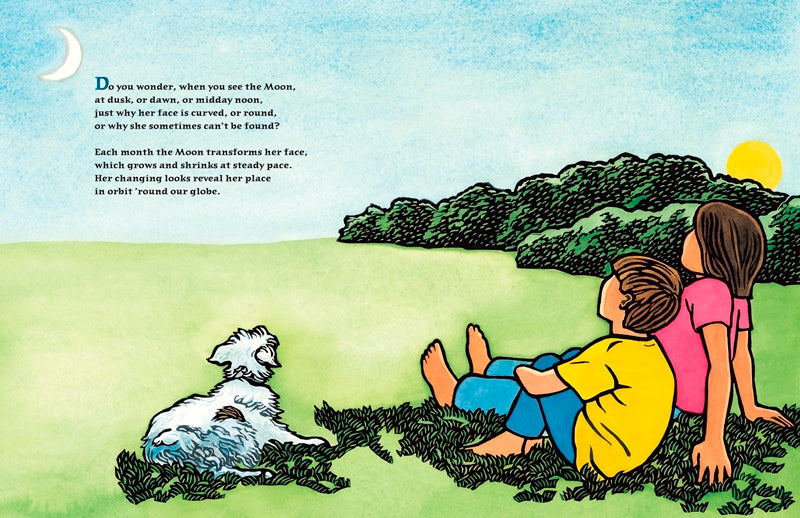
The first page starts with a question “Do you wonder…?” as we see two children looking up at a crescent Moon with the Sun sinking behind them. In two short verses, the author sets the scene. This is followed by a page by page description of each phase of the Moon in four lines of carefully worded verse. So, after the new Moon we turn the page to read
“A few days pass and Moon’s less shy
Her smile lights the twilight sky.
The more her sunlit surface shows
The more the Moon’s WAXING CRESCENT grows.”
At the bottom of each page we are told when that phase of the Moon rises and when it sets. Once
again, the language is simple and clear
“Waxing Crescent Moon rises in the mid-morning and sets in the mid-evening.”
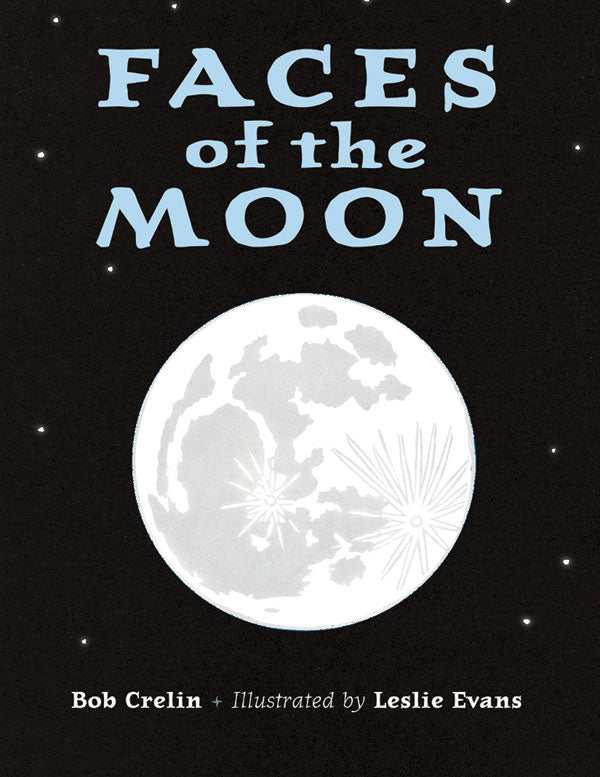
This is a delightfully tactile book. The immediate appeal of the book is the cover with its big cut away full Moon on a black background. Most pages have its aperture of the Moon. The reader’s eye is drawn from the waxing crescent Moon through its aperture, to the full Moon and then back, page by page, to the new Moon. Another attractive feature is that each page has a picture thumb index showing the phase of the Moon described on that page. This makes a pleasing pattern down the side of the book.
Faces of the Moon stands as a book on its own but it can also be used as part of an interactive classroom lesson. An eight page illustrated lesson plan can be downloaded from the website. With some preparation, including the creating of a very dark room which may be difficult, children can turn their own Moons through the phases of the lunar cycle. I tried a simplified version of this with several seven year olds. They enjoyed talking themselves through the phases and then relating this activity to the book. A clever Moon Gazers Wheel, appropriate for the northern hemisphere, is also available and would
make a good addition to the book, tucked into a pocket at the end. There are instructions on the back for its use. By noting the face that you see, the reader can match it up on the dial and read off what its name is, when you can see it in the sky, and when and where that Moon rises and sets. There are, however two points of confusion. It is possible to read off, for instance, that the full Moon can only be seen at midnight, and that at any given phase of the Moon it can be seen in the sky for a full twelve hours. I would suggest a little more explanation is needed. But in spite of this, the wheel is an intriguing piece of equipment for the older child and even for adults. Faces of the Moon does what it sets out to do. It simply describes, explains and names the phases of the Moon. But it does more than that. By asking the question at the beginning and then at the end, putting the Moon in the context of our Universe.
“The Moon reminds us of our place
A spinning world in endless space.”
The author appeals to the curiosity and the wonder that is at the heart of every child. Faces of the Moon should be on the shelf in every school for both teachers and children to use when studying topics such as Night or The Solar System or Light. For the home it would not only become a well thumbed reference book but a favourite book to choose to share at bedtime.
Astronomy
If you've ever doubted that the elegance of the night sky can be expressed poetically, you haven't encountered bob Crelin's young readers' book Faces of the Moon. With a marvelous blend of science and rhyme, Crelin tells the story of the Moon's phases in a way that a youngster (and many adults) will understand and appreciate. Bob's verse and artist Leslie Evans' beautiful illustrations bring to life a complete cycle of the Moon's phases, from one New Moon to the next.
Each phase is covered in a two-page spread comprising Crelin's poetic description and Evan's artistic rendering of the Moon's appearance and location at that time. A unique feature of Faces of the Moon is the cutout windows that "animate" the phases as you turn the pages. Index tabs depicting the various lunar phases make it easy to target a specific phase—a kid-friendly approach that eliminates the need for a table of contents or index. Faces of the Moon concludes with an explanation of the Moon's orbit and phases and a list of Moon facts (done in rhyme, of course!)
I learned about Faces of the Moon during a talk presented by Bob Crelin at the Conjunction Convention last summer. His enthusiasm was so infectious that I immediately purchased a copy of his book for my grandchildren. Recently, I took my 5-year-old granddaughter, Katie, outside to look at the Moon, both with the unaided eye and through my telescope. I then brought her inside, took out her copy of Faces of the Moon, and asked her to point to the index tab that showed the Moon the way we had seen it. She correctly pointed to the First Quarter Moon. She may have been a bit too young to understand orbits and shadows, but she had no trouble matching what she saw outside with its corresponding page in the book. A few months of showing her the real Moon and follow-up references to Faces of the Moon, and Katie will have a better handle on the Moon's phases than most adults (except, of course, those who purchase the book for their own children).
Teachers looking for a book describing the Moon's phases can do no better than Faces of the Moon.
Mother Reader
Every once in a while an obvious fact hits you in the face and alters your own perception of the world. Like when you (I) realized that the phrase wasn't "for all intensive purposes" but instead "for all intents and purposes." Then you (I) look over the past for all the times this fact came into play and was misunderstood by you (me).
That's how I felt after reading the nonfiction picture book Faces of the Moon, by Bob Crelin. The author takes us through the phases of the moon and how what we see in the sky is affected by the sun's shining on the moon's surface combined with the moon's orbit. The cut-outs on the pages emphasize the moons shape though its cycle, and echo the dynamic cut-out on the book's cover. All through the book, rhyming couplets describe the phases, with my favorite rivaling the whole Thirty days hath September bit:
Each changing face (or lunar phase)
repeats each nine-and-twenty days;
from thin to thick, from dark to light;
sometimes in day, sometimes at night.
The illustrations of Leslie Evans are created from linoleum block print and watercolor. They are lovely, but what captures me most about the pictures is the story that is told in them alongside the facts about the moon. It seems to be about a boy who is visiting a girl - a cousin? a sister? - in the countryside. He goes home to the city and they talk on the phone looking at the shared vision of the moon out their windows. Then at the end he comes back to the countryside, and they sit on the steps together. I found myself dying to know the story of these two kids, but I suppose that's my fictional favoritism coming into play.
So what was my great revelation? While I knew about phases of the moon and why they happen and all that jazz, it never occurred to me that the specific phases are connected to particular times of day. For instance, the waning crescent moon rises hours before sunrise and sets in mid-afternoon which is why we always see that particular shape in the morning. Of course I noticed different shapes of the moon, but I never gave it a thought as to what shape appeared at what time of day. Totally eye-opening.
Anyway, this is a lovely, interesting book for kids - or oblivious adults - to find out more about the moon. And maybe to make up a story about the two kids in the picture, so there are some storytelling prospects mixed in as well.
Hardcover
ISBN: 978-1-57091-785-1
Ages: 6-9
Page count: 36
8 1/2 x 11