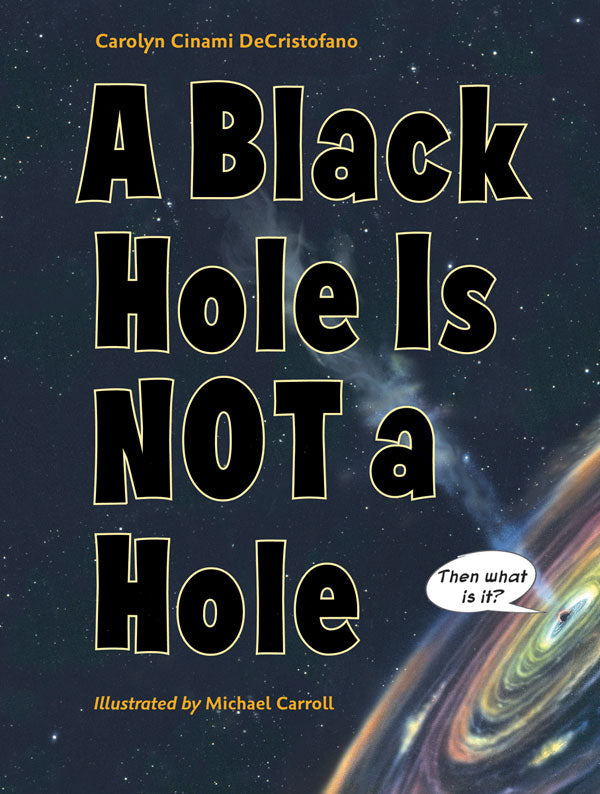
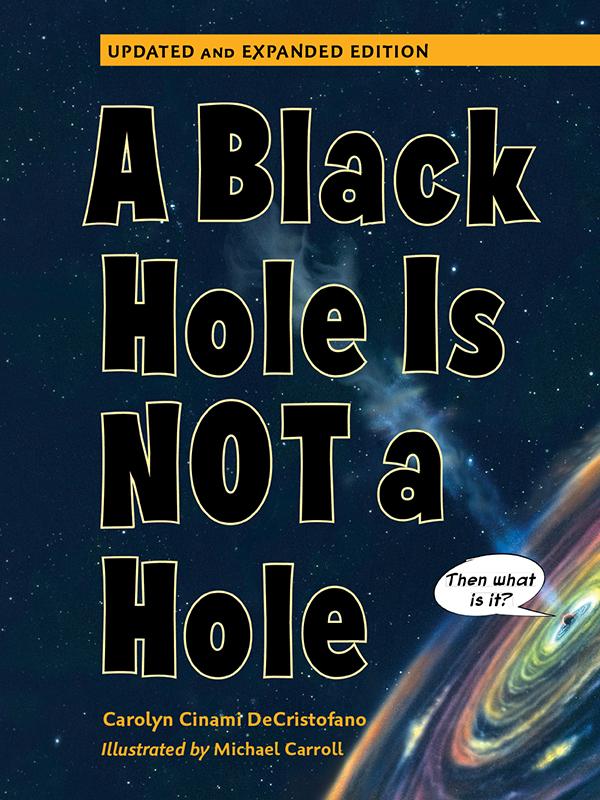
A Black Hole Is NOT a Hole

Carolyn Cinami DeCristofano, author
Carolyn Cinami DeCristofano has been named a Creative Teaching Partner (specialty: Curriculum and Planning) by the Massachusetts Cultural Council. Carolyn is an artist who can work effectively with educators, schools, districts, etc., to help integrate the arts (in this case, writing) into the broader school curriculum.
Carolyn is the author of Leonardo's ABC's (Museum of Science, Boston). She has developed science programs with NASA and the Harvard-Smithsonian Center for Astrophysics.
Carolyn lives in Plympton, Massachusetts.
Click here to read Charlesbridge's interview with Carolyn!
Read more about Carolyn.
Michael Carroll, illustrator
Internationally known artist Michael W. Carroll has been painting astronomical subjects for over 20 years. He has done commissioned work for NASA and the Jet Propulsion Laboratory. His art has appeared in several hundred magazines throughout the world, including Time, Smithsonian, National Geographic, and Astronomy. His paintings have aired on NOVA, COSMOS, and various TV specials, and have embellished albums and numerous books, including works by Carl Sagan, Arthur C. Clarke, David Brin, Terence Dickenson.
Mike is also a science journalist, with articles appearing in Popular Science, Astronomy, Sky & Telescope, Artists, and Earth magazines. His articles and stories have also appeared outside the U.S., including Australian, Japanese, and British publications. His first book, Visions of the Revelation, was an illustrated version of the last book of the Bible. He wrote and illustrated a series of children's books, which includes Spinning Worlds (Cook), Volcanoes & Earthquakes (Cook) and more. With his wife, Caroline, he has written two daily devotionals based on science: Absolutely Awesome (Tyndale), along with Exploring Ancient Cities of the Bible (Cook), and Gold Medallion finalist Dinosaurs (Cook).
Mike lives with his inspiring and wonderful co-author, business manager, and wife (all three of them have met), and fine kids Andy and Allie at the foot of the Rockies in Littleton, Colorado.
Read more about Mike.
- A Junior Library Guild Selection
Kirkus Reviews, starred review
Oh, my stars! As the cover proclaims, a black hole may not be an actual hole, but readers will be glad they fell into this book.
The volume guides readers on a (literally) out-of-this-world tour, dealing with topics and concepts that, in the hands of a less-gifted writer, might have remained obscure and unclear. DeCristofano handles the material with wit, style and singularly admirable clarity, frequently employing easy-to-understand and, yes, down-to-earth ideas and scenarios to help make complex principles comprehensible to readers of all ages. Carroll's illustrations, diagrams and charts, along with superb telescopic photographs (many courtesy of NASA) are splendid and filled with the drama and excitement of the limitless vastness of space. The handsome design and visuals greatly enhance the text and add much to readers' grasp of the subject. Stargazers will be entranced, and even those not especially attuned to matters celestial will come away feeling smarter, awestruck and with a sense of finally understanding this fascinating, other-worldly phenomenon. An excellent resource.
Hole-y astronomy!
Writing with rare verve ("A black hole is nothing to look at. Literally."), DeCristofano condenses recent astronomical discoveries into a high energy account of what we know or guess about one of the universe's deepest and most unobservable secrets. Covering the life cycle of stars; the formation of black holes and weird optical and physical effects associated with them; more recent revelations of super-sized black holes at the centers of galaxies; and the general effects of mass on space, light, and matter, she presents a clear, well-rounded picture of the strange structure and stranger physics of black holes. After leading a wild ride over a black hole's event horizon ("Right away, you would need a new nickname--something like Stretch . . . .") and explaining theories about gravity from Newton's notions to "Einstein's Spacey Ideas," DeCristofano leaves readers to ponder the truth of her claim that a black hole isn't a hole--but "NOT exactly NOT a hole either." Enhanced by a time line and a generous set of further resources--and illustrated with plenty of cogent diagrams, space photographs, and Carroll's dramatic images of stellar whirlpools and mammoth jets of gas around cores of impenetrable blackness--this book will snatch readers from their orbits and fling them into a lasting fascination with nature's most attractive phenomena. Literally.
This introduction to black holes takes readers from simple to complex by dropping definitions and information slowly and clearly into the lively narrative. Dramatic and amazing illustrations help to impart the sense of the vast distances in space, of how atomic nuclei meld in the intense interaction called fusion, and how the areas of a black hole--the event boundary, the extreme gravity zone, and the singularity--are defined. The appended time line begins with Newton's work on gravity in 1687 and ends with the theoretical shining of a flashlight toward our galaxy's black hole (Sagittarius A*, with a mass four million times that of our Sun) in 2012, which would take about 3600 years to reach its goal. The author's list of print resources credits classic science titles. Her website list cautions that the sites may not stay current, and she recommends using a search engine to get at the most up-to-date data. A four-page glossary provides succinct definitions and some pronunciation guides. The one-page index leads readers back to the text for many of the terms found in the glossary, e.g., "spaghettification," as well as for many of the scientists mentioned throughout. Informative, fun, and so beautiful that even general readers will be drawn into it.
Black holes--the remnants of former massive stars-may provide fascinating play for the imagination (especially for science fiction fans), but the physics behind them can be equally captivating, particularly when presented with the explanatory skills exhibited in this book. Complicated abstract ideas, such as gravity, electromagnetism, and relativity, are logically ordered and clarified in an inviting conversational style and with inspired uses of reasoning and analogies that are perfectly attuned to the comprehension levels of the target audience. DeCristofano starts with the intriguing title statement, then goes on to discuss the main feature of black holes (their immense gravitational "pull"); the conditions of their formation; the ways in which they capture light (the "black" in black hole); and the evidence and detection techniques used by scientists to determine where they exist. The well-designed layouts include illustrations of stars, black holes, and other space phenomena; historical images of astronomers; helpful diagrams; and humorous text bubbles that add levity while underscoring major concepts.
National Science Teachers Association
Any middle school or upper level elementary science teacher who delves into astronomy is sure to find students who either have some knowledge about black holes or want to find out more about them. Clearly, the idea of black holes has sparked our imagination, most especially that of children. This sound reference to the topic will engage students from middle elementary through high school.
With this book, Carolyn Cinami DeCristofano delivers the goods on several levels. First, she deals with the most basic questions: What are black holes? How do they form? Could we visit one? How did astronomers discover them? What would happen if an astronaut approached one? In an extraordinarily clear series of explanations concerning what could be an impossibly complex topic, the author provides understandable answers to each of these questions and more. While her answers are clear, they are not simplistic, in that she does not talk down to the young reader. Students will need to follow a reasonably detailed narrative, but DeCristofano's prose is laced with so much humor and such well constructed metaphors that readers will breeze through it with pleasure.
Students will discover the present state of knowledge about black holes not only through the text, but by means of beautifully rendered paintings, clever graphics, and some space photography. The author, illustrator (Michael Carroll), and the editors have constructed an attractive volume which will serve students well. The book's design and supplementary resources including timeline, glossary, index, and extra references, stretch its usability. A teacher who needs to brush up on details of deep space astronomy or the nature of gravity would do well to read this book with care before beginning an astronomy unit with his/her class.
Library Media Connection
This is a perfect book for the young scientist. It takes the reader on an historical tour of black holes from their hypothesized existence in the early 1900s through today's knowledge, research, and theories. Using photographs and realistic illustrations, the information is presented in a clear and understandable fashion. Throughout the book the author interjects humorous pictures and speech bubbles making all the scientific information a little easier to handle. The text and ideas presented can be a little complex at times, making it best suited for stronger readers. This book is a complete resource offering a timeline for the discovery of black holes, an extensive glossary, an informative author's note, and both book and website resources.
Reading Today Online
Carolyn DeCristofano hits a home run with this fascinating book about black holes. She takes a sophisticated scientific topic and breaks it down into clear, manageable concepts that middle grades readers will be able to grasp, beginning with easier concepts and gradually moving to the more complex ideas. Through the skillful use of figurative language and comparisons and contrasts, DeCristofano helps readers understand extreme gravity zones and the distortion of space that happens as dense matter interacts with it. Two extended comparisons–a black hole being like a whirlpool and being similar to a hole in an object–help readers to visualize the abstract scientific principles at work in black holes. Readers are also guided through "thought experiments" to image how light is absorbed and bent by black holes as well as what it might be like to travel into a black hole. Descriptions of recent scientific explorations of black holes and "supermassive" black holes will leave readers with additional inquiries that can be investigated with the support of the backmatter and references listed at the end of the book. A Black Hole is Not a Hole is a powerful informational book that helps children understand the world, our solar system and galaxy, and the galaxies beyond.

Paperback
ISBN: 978-1-57091-784-4
Hardcover
ISBN: 978-1-62354-308-2
E-book PDF
ISBN: 978-1-60734-073-7
Ages: 9-12
Page count: 80
7 1/2 x 10
Correlated to Common Core State Standards:
English Language Arts-Literacy. Reading Literature. Kindergarten. Standards 1-7, 9, 10.
English Language Arts-Literacy. Reading Literature. Grade 1. Standards 1-4, 6, 7, 10.